Research & Publications
I build and analyze dynamical systems models, often from data, to understand how networks of interacting parts produce collective behavior.
Papers are grouped by topic below. For a full list, see Google Scholar or my CV. Code for most papers is on GitHub.
Neural dynamics and behavior
The nematode C. elegans has a fully mapped connectome and can be imaged neuron by neuron, which makes it a test bed for connecting network structure to behavior. I build models, constrained by the connectome and fit to whole-brain imaging, of how neural activity switches the worm between behavioral states such as forward and reverse locomotion. Current work uses community detection and dimensionality reduction to find low-dimensional descriptions of these dynamics, and calibrated matching methods to identify neurons in whole-brain recordings. Earlier work studied memory retrieval in damaged Hopfield networks.
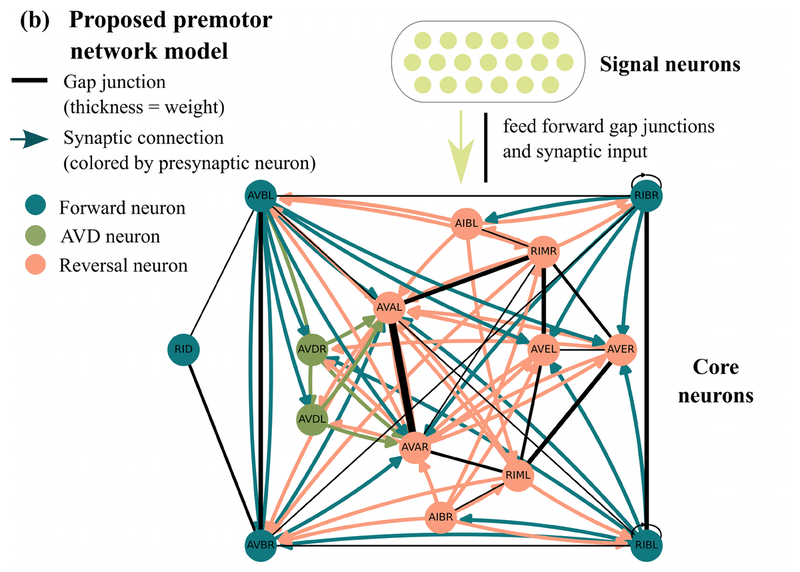
A data-driven biology-based network model reproduces C. elegans premotor neural dynamics
PLOS Computational Biology, 21(12): e1013818 (2025)
A minimally parameterized, connectome-constrained model of the C. elegans premotor network. Driven by realistic inputs, it reproduces the switching between forward and reversal behavior seen in whole-brain imaging and identifies the neurons that most strongly influence those switches.
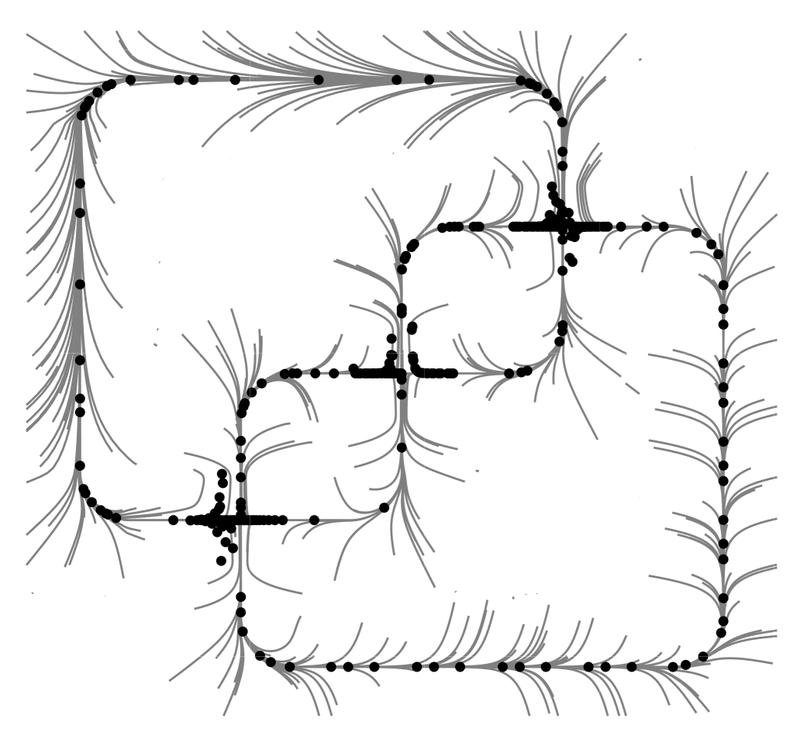
Chaotic heteroclinic networks as models of switching behavior in biological systems
Chaos: An Interdisciplinary Journal of Nonlinear Science, 32(12): 123102 (2022)
Deterministic chaotic heteroclinic networks as an alternative to Markov chains for modeling switching between behavioral states. They reproduce dwell times and transition statistics from C. elegans experiments.
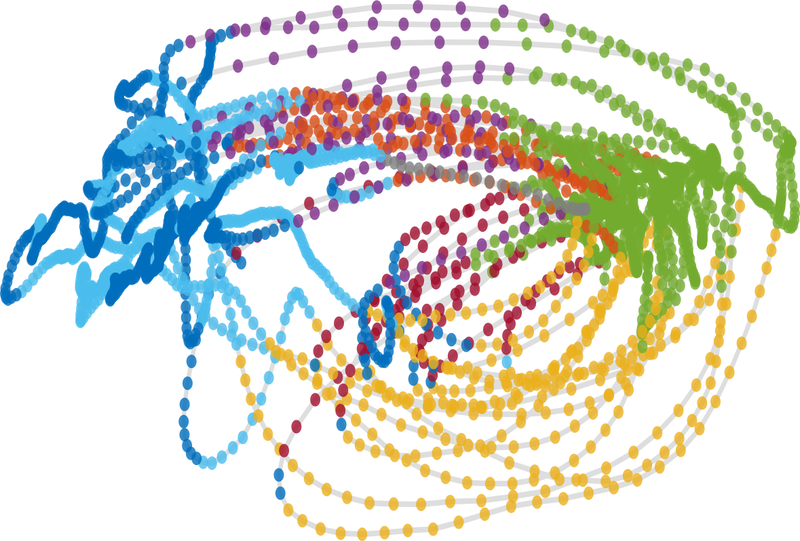
Nonlinear control in the nematode C. elegans
Frontiers in Computational Neuroscience, 14: 616639 (2021)
A global nonlinear control model, fit to whole-brain calcium imaging, that captures transitions between behavioral states in a single dynamical system.
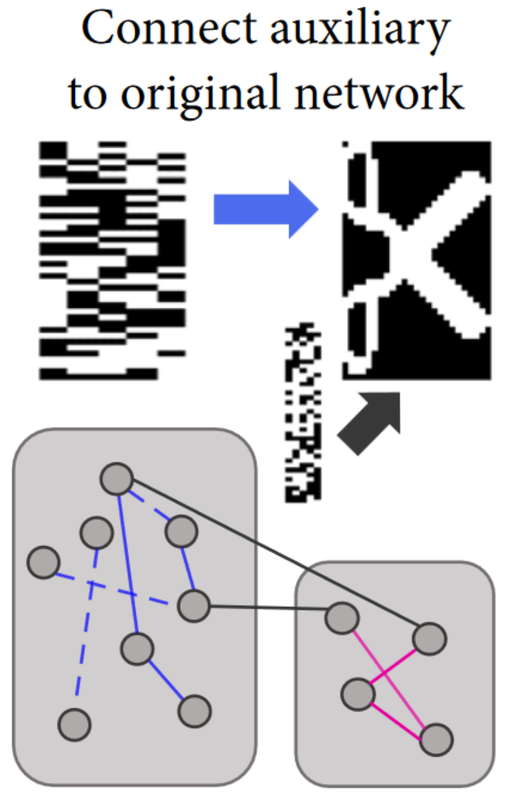
Preventing neurodegenerative memory loss in Hopfield neuronal networks using cerebral organoids or external microelectronics
Computational and Mathematical Methods in Medicine, 2017: 6102494 (2017)
A computational study of whether an auxiliary network, modeling a brain-machine interface, can restore memory retrieval in a damaged Hopfield network.
Koopman eigenfunctions and exact solutions of nonlinear ODEs
Koopman eigenfunctions turn a nonlinear system into a linear one in new coordinates. When those eigenfunctions can be found exactly, so can the solution of the ODE. I construct eigenfunctions from invariant manifolds, and in collaboration with Sonja Petrović, I study which polynomial ODEs have rational eigenfunctions and hence closed-form solutions.
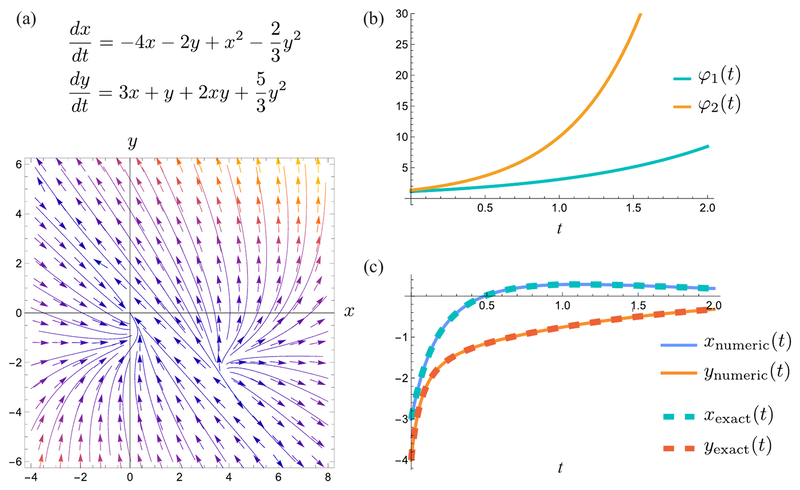
Analytical solutions for some quadratic ODEs found via linear rational eigenfunctions and the rational eigenfunction variety
Submitted to SIAM Journal on Applied Dynamical Systems (2026)
We find exact, closed-form solutions to families of two-dimensional quadratic ODEs by constructing Koopman eigenfunctions that are rational functions, and describe the algebraic variety of ODEs that admit them.
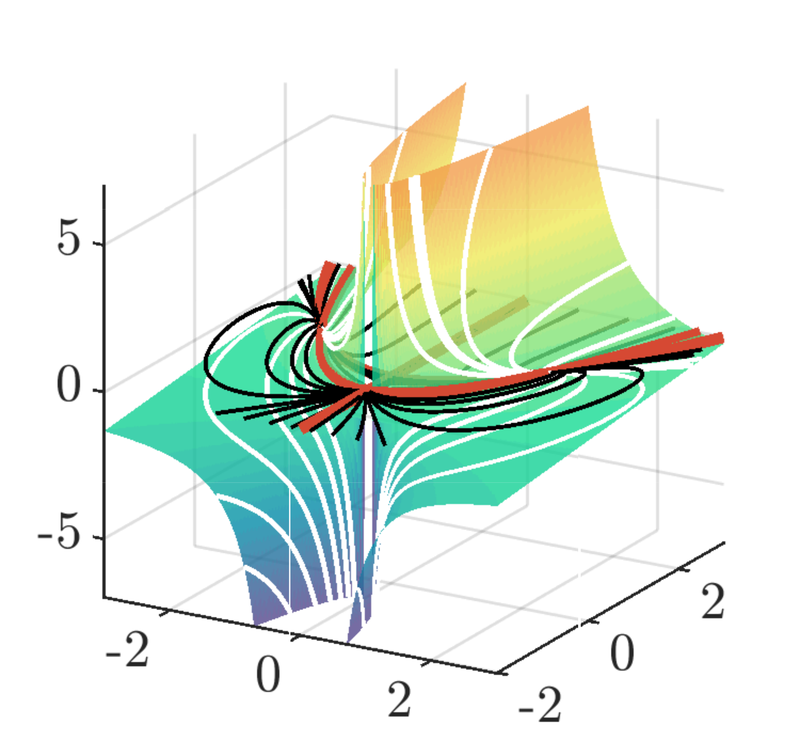
Solving nonlinear ordinary differential equations using the invariant manifolds and Koopman eigenfunctions
SIAM Journal on Applied Dynamical Systems, 23(1): 924–960 (2024)
We build Koopman eigenfunctions from the invariant manifolds of a nonlinear ODE and use them to write down analytical solutions, including for systems with multiple fixed points.
Data-driven modeling, model selection, and control
Methods such as SINDy discover governing equations from data, but in biology data are often scarce while the library of candidate models is large. My group studies when the correct model can be identified in this regime, and how to choose sampling strategies that give the most information for model selection. Earlier work used discovered models to design control signals.
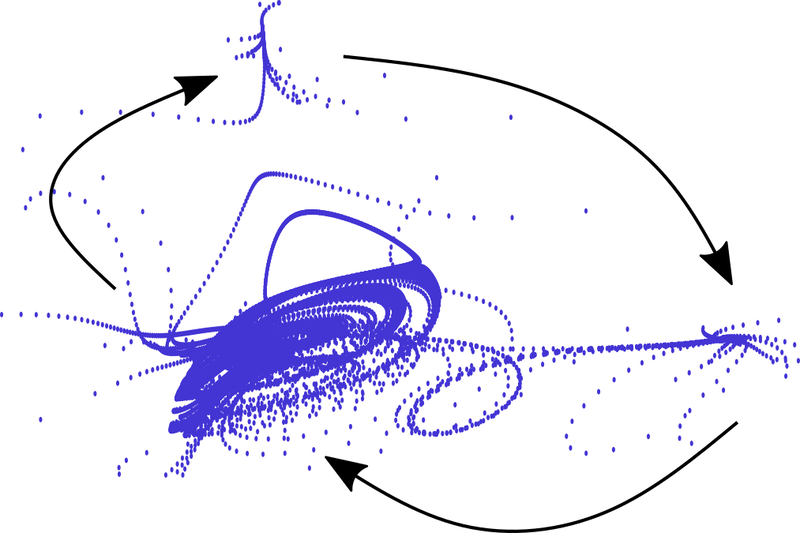
Nonlinear control of networked dynamical systems
IEEE Transactions on Network Science and Engineering, 8(1): 174–189 (2021)
Combines dimensionality reduction, SINDy model discovery, and bifurcation theory to find feed-forward control signals that move high-dimensional networked systems between fixed points.
Signed networks, cooperation, and conflict
In signed networks, ties can be friendly or hostile. With Michael Gabbay and Nathan Kutz I studied structural balance dynamics on these networks: when communities can be detected, which factions emerge, and how a network of states can tip abruptly from peace into systemic war.
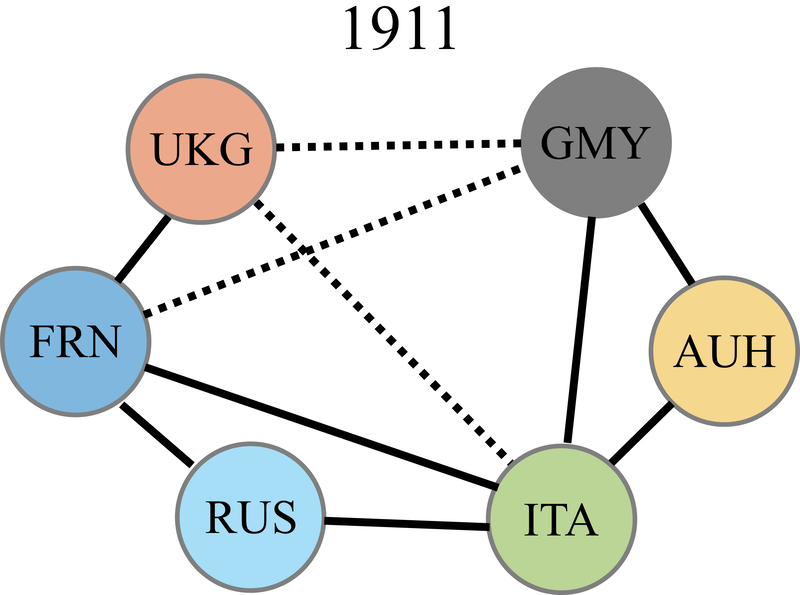
Transitions between peace and systemic war as bifurcations in a signed network dynamical system
Network Science, 11(3): 458–501 (2023)
A signed network model of cooperation and conflict between states shows a sharp bifurcation from peace to systemic war as structural balance pressure grows. We apply it to the European great powers before World War I.
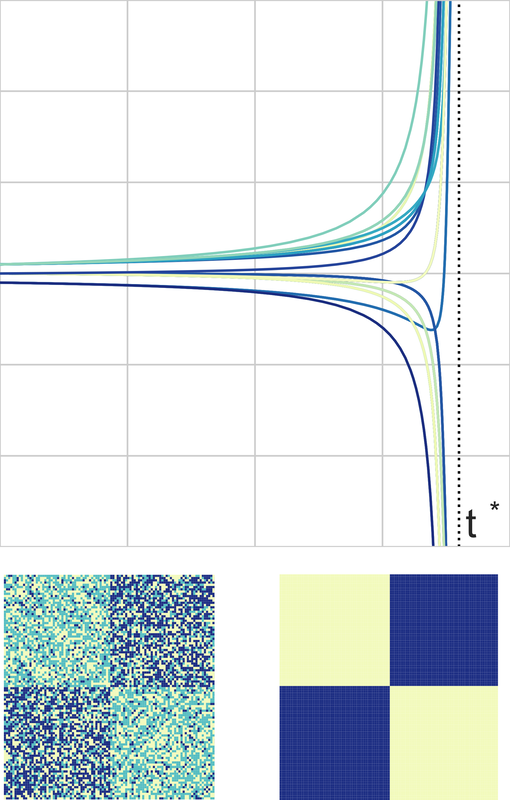
Community detectability and structural balance dynamics in signed networks
Physical Review E, 102(1): 012304 (2020)
Spectral detectability transitions in signed networks with community structure predict which factions emerge under structural balance dynamics.
Funding
- NSF REU Site: Summer Undergraduate Research Experience (SURE) at Illinois Tech, Award #2548498, 2026–2029 (Co-PI; PI Yuhan Ding)
- NSF Mathematical Sciences Postdoctoral Research Fellowship, Award #2103239, 2021–2024